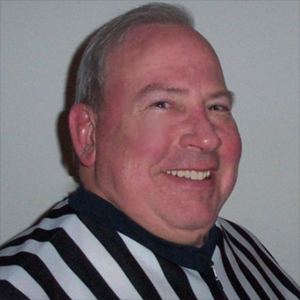
Rndballref
20 Years Experience
Chicago, IL
Male, 60
For twenty years I officiated high school, AAU and park district basketball games, retiring recently. For a few officiating is the focus of their occupation, while for most working as an umpire or basketball referee is an avocation. I started ref'ing to earn beer money during college, but it became a great way to stay connected to the best sports game in the universe. As a spinoff, I wrote a sports-thriller novel loosely based on my referee experiences titled, Advantage Disadvantage
Here are the screening rules:1) Stationary B1: A2 is setting a pick and B1 can see the pick within his visual field, then A2 can set the pick anywhere short of contact. If B1 cannot see the pick within his visual field, A1 must set the pick no closer than 1 normal step.2) Moving B1: When screening a moving opponent, the rule book says he must be given time and distance to avoid the pick. The speed of the opponent is a key to allowing this distance and may be one or two steps, all in the judgement of the officials3) Moving B1 and A1, the player moving behind the direction they are moving is responsible for contact.
Share Answer: 

In NFHS rules, a non-free thrower cannot enter the lane until the ball hits the rim or backboard. Assuming there was no harsh contact and that the player blocking out entered after the ball hit something (or went in) this should be a no call.
Share Answer: 
Yes, because the line is out of bounds.
Share Answer: 
yes if he changes the call right away. it looks sloppy, but if it is the right thing to do he should reverse it.
Share Answer: 
Magician
 How do you feel about magicians on TV who reveal how tricks are done?
Hotel Employee
 Can you give guests room upgrades at your sole discretion?
Bouncer
 What's the best way to "get in good" with the bouncer at the door?
To move from the backcourt to frontcourt all three points have to advance to the frontcourt...2 feet and the ball. So if a dribbler moves from the backcourt with one foot advancing as well as the ball into the frontcourt, BUT the other foot is stepping on the half court line he is considered to be backcourt.
Share Answer: 
Here is the definition of "held ball" in the rule book:
A held ball occurs when 1…opponents have their hands so firmly on the ball that control cannot be obtained without due roughness, or 2…an opponent places his/her hands on the ball and prevents an airborne player from throwing the ball or releasing it on a try.
In the first instance, control cannot be obtained. In the second instance the offensive player starts with control but then loses the ability (i.e.. control) to pass or shoot. So I think you are splitting hairs - each of you are right and wrong in definition 1 vs 2.
Share Answer: 
If team A controlled the tap, then they established team control, and it would be a backcourt violation. If in the judgement of the officials team A did not control the tap, then no violation.
Share Answer: 
-OR-
 Login with Facebook
 (max 20 characters - letters, numbers, and underscores only. Note that your username is private, and you have the option to choose an alias when asking questions or hosting a Q&A.)
(A valid e-mail address is required. Your e-mail will not be shared with anyone.)
(min 5 characters)
By checking this box, you acknowledge that you have read and agree to Jobstr.com’s Terms and Privacy Policy.
-OR-
Register with Facebook(Don't worry: you'll be able to choose an alias when asking questions or hosting a Q&A.)



 Browse Jobs
 Host a Q&A
 Search

 Submit Your Question
 Host a Q&A
 Last 7

